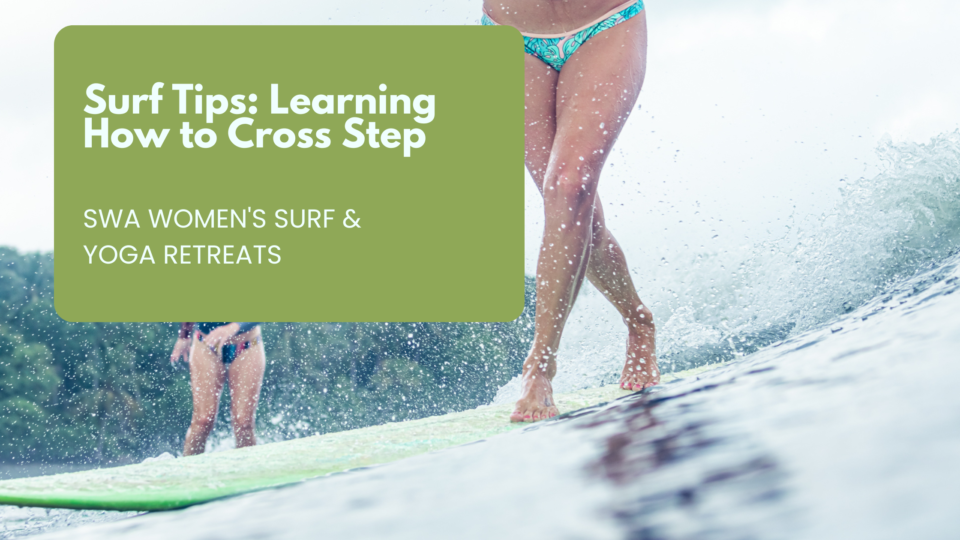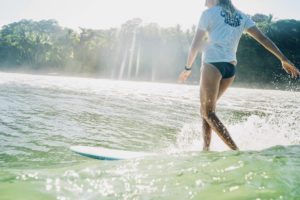

There’s nothing quite like the feeling of gliding to the nose—weightless, piggies over the edge, wave peeling beneath you like silk. But behind every dreamy hang-five is a solid setup: timing, positioning, and body and wave awareness. Our favorite places to do it are in Southern Costa Rica and in Morocco! If you’re working on your cross-step and noseride technique, here are three classic approaches to help you find your flow:
1. Stall to Stay in the Pocket
Especially when the wave is slow and not quite a perfect, tall, nose-rideable wall in front of you, don’t rush your cross steps! Shift your weight back to gently stall (or even step back with your back foot)—this lets the wave catch up and allows you to situate yourself in that perfect little pocket of speed and power, in between the breaking wave and open face. Once you feel the tail of your board held down by the breaking wave, begin cross-stepping forward with smooth, slow, deliberate steps. You’ll likely start to levitate up towards the top 1/3 of the wave, this is where you want to stay! Remember: good posture is key. Tuck the tush, push the bush—hips forward, chest back—to stay light and balanced over your board. Don’t forget to keep your eyes up looking at the section in front of you! You may even need to repeat this tactic several times on one wave to set up again.


2. Go Straight to the Nose on a Fast Section
If the wave is steep, speedy, and forming a nice tall wall down the line, don’t hesitate. Angle your line high by leaning on your inside rail, trim along the top 1/3 of the wave and go for your cross steps. Because the tail of your board is already held down by the breaking wave in this scenario, you’re already set up, just focus on staying centered and keep your steps in control! Again, that “tush-tucked, bush-pushed” posture helps keep your weight evenly distributed for better control and style points.


3. Use a Big Bottom Turn to Set Your Line
This technique will help you to slow things down while setting up for the noseride of your dreams. Try a deep bottom turn. This technique will not only help you stall if you’re not quite in the right place on the wave, but also will help you generate speed to propel you to the upper third of the wave as you take your first steps. After bottom turning, take your first step forward as you float up the wave and settle in for that long glide.
Finally, noseriding is way more fun when you’re warm, flexible, and confident in your gear. That’s why we love Mamala wetsuits—designed by women, for women, with buttery soft neoprene and cuts that move with you (and yes, they look good on the nose, too).
Want to break it all down even more? Surf With Amigas Online is your go-to for tutorials, noseride tips, and feedback from experienced instructors. Whether you’re a few steps in or already hanging ten, there’s always more to learn—and more fun to have along the way!